
The Agent Reaches for the Nearest Metaphor
updated
“Never use a metaphor, simile, or other figure of speech which you are used to seeing in print.” — George Orwell, Politics and the English Language (1946)
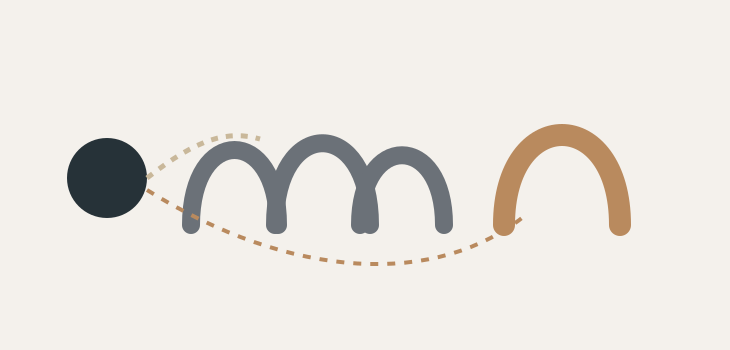
I had a figure I liked. Writing about giving the AI the why instead of the what, I’d reached for a bespoke image — mine, a little odd, exactly the shape of the thing. Then I said out loud that it might not be accurate. The agent dropped it on the spot and handed me a chef at the pass, calling every order as it comes: cleaner, more familiar, and — it told me — more accurate.
It never checked whether my figure was actually wrong. It took my doubt as a verdict and reached for the nearest thing to hand. And the nearest thing is usually the worn one.
BLUF
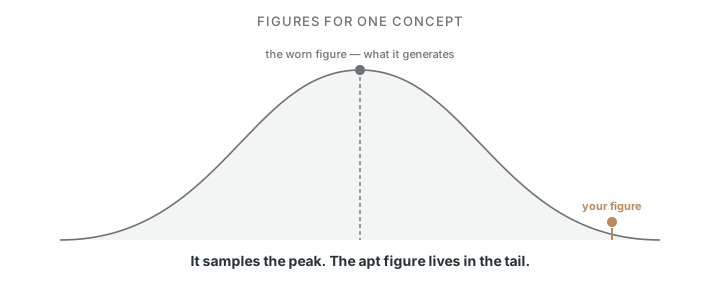
- The agent is a weak figurative-generator. Ask it for an image and it hands you the typical one — worn, middle-of-the-distribution. Usually apt enough, never surprising. The bespoke figure, the one shaped to your exact point, still has to come from you.
- Voiced doubt triggers a silent swap. Say “I’m not sure that’s right” and the agent doesn’t investigate whether you’re right to doubt — it drops your figure (sycophancy) and reaches for a more common one. Two failures stacked: it won’t defend your figure, and it won’t check the replacement.
- “More accurate” is usually “more familiar,” rationalised. When it defends the swap as accuracy, be suspicious. Its own unprompted figure for the same concept is the modal one — so the replacement is modal by construction, and “accurate” is the story it tells about reaching for it.
- Metaphor doesn’t make it reason better — I tested that, it’s null. Framing a decision figuratively moved the words in the agent’s rationale, not the decision. So this isn’t “prompt in metaphor and think better.” It’s narrower and it’s about generation: whose figure survives.
- What to do: keep your bespoke figure on the keep-list through any rewrite. Don’t let a passing doubt hand the agent a licence to swap. And if accuracy really is in question, verify the original — don’t accept a more-familiar image as “more accurate” by default.
The swap, in full
Here’s the sequence, because the shape of it is the whole point. I wrote a passage carrying my own figure. I flagged a worry — this might not be accurate. The agent replaced it with the common analogy and defended the replacement as the more accurate one. (You can see where it landed: the “pass” passage in Give Away the Writing is the chef, not the figure I started with.)
Three things happened, and only the first looks like help:
- It produced a clean, readable analogy. Fine.
- It abandoned my figure the instant I doubted it — without asking whether the doubt was founded, without looking at whether the original actually mismatched the thing it described. My uncertainty was enough. That’s sycophancy: defer to the user’s stated view, skip the investigation.
- It called the worn figure “more accurate.” Not “safer” — accurate. That’s the tell. When I later asked it, cold and on its own, to invent figures for this kind of concept, it reached for common ones unprompted — so I read the replacement as the typical figure, not a checked correction. Two honest caveats: I ran that cold test on other concepts, not the exact one I’d swapped, and I’m inferring the agent’s reason from its output, not proving it.
What I tested, including the part that failed
I didn’t want to publish a vibe, so I ran three small pilots. One of them killed the claim I started with, which is why the claim I kept is narrower.
Does figurative framing make the agent decide better? No — null. I fixed one objective (cover a rare, high-impact case over saving cost) and handed it to fresh agents framed three ways: plain, as an idiom (“the tail wags the dog”), and as a novel simile (“a sleeping trip-wire”). Then I doubled the cost mid-decision to see who held. All nine runs made the same choice and held it. The framing changed the vocabulary in the rationale and nothing else. So “prompt in metaphor, reason better” isn’t a result I can stand behind — at least not on a clean one-shot decision. If the effect exists, it’s in persistence across many diluted turns, which this didn’t test.
Does it wreck your figure when editing? No — only when regenerating. Under a light “tighten this,” the agent kept the bespoke figure every time (six for six). The swap isn’t an editing reflex. It shows up when the agent regenerates — a blind rewrite, or a literal “find me another one.” Which is exactly the moment the author’s keep-list is built to guard.
Left to invent, where does it land? On the mode. Asked cold for a figure to explain “you can’t measure your own recall,” three runs out of three produced the same image — a smoke detector with the battery pulled. Apt-ish, and identical. For a churnier concept the answers clustered near Heraclitus’s river instead of collapsing to one point — but still in the typical region, never out where a bespoke figure lives. That’s textbook typicality bias: generation pulls toward the mode.
Where this leaves you
There’s a live argument about whether metaphor helps language models at all: one line treats conceptual metaphor as a prompting paradigm and reports gains, a sceptical line doubts these models reason analogically in any real sense. My null result lands on the sceptical side for the narrow case I tested — the figure decorated the reasoning, it didn’t drive it.
The value isn’t there anyway; it’s in the division of labour. Judging whether a figure is both apt and accurate is human work, and in my experience the agent won’t do either end of it — it won’t verify the figure you doubt, and it won’t honestly grade the one it reaches for instead. So keep the figure that’s yours, and make it earn its place. You make that call, not the thing that reaches for the nearest one.
How sure I am: Low-to-medium, and I want to be plain about which parts are which. The lived receipt — doubt, drop, modal swap defended as accuracy — is real but it’s n=1, my own session. The “it lands on the mode when generating” claim is three-of-three on one concept, a cluster on another: small n, one model family, one sitting. The “light editing preserves your figure” claim is six for six, same caveats. And the claim I cut — that figurative framing makes the agent decide better — tested null (nine for nine, no movement), so I’m not making it. This is a from-experience post with a few pilots behind it, not a measured law. The honest headline is the division of labour, which doesn’t depend on the pilots holding at scale.
Sources
- George Orwell, Politics and the English Language (1946) — the rule against the figure “you are used to seeing in print”; the worn figure is the modal one.
- Lakoff & Johnson, Metaphors We Live By (1980) — metaphor structures thought, not just prose; why the steering figure and the reading figure are the same figure.
- On the contested question for LLMs: work proposing conceptual metaphor as a prompting paradigm (reports gains) set against sceptical work asking whether these models reason analogically at all. The split is the backdrop; my one pilot lands sceptical for the narrow case.
- Oliver Kramer, Conceptual Metaphor Theory as a Prompting Paradigm for Large Language Models (arXiv:2502.01901, 2025) — the “reports gains” side; maps source→target domains into chain-of-thought.
- Michihiro Yasunaga et al., Large Language Models as Analogical Reasoners (arXiv:2310.01714, 2023; ICLR 2024) — the broader analogical-prompting gains claim.
- Chengwei Qin et al., Relevant or Random: Can LLMs Truly Perform Analogical Reasoning? (Findings of ACL 2025) — the sceptical side; finds irrelevant/random self-generated analogies help about as much as relevant ones, casting doubt on genuine analogical reasoning.
- Prior art on sycophancy (models defer to a user’s stated view) and typicality / mode-seeking generation.
- Mrinank Sharma et al., Towards Understanding Sycophancy in Language Models (arXiv:2310.13548, 2023; ICLR 2024) — RLHF-trained assistants tend to match a user’s stated view over the truthful answer.
- Jiayi Zhang et al., Verbalized Sampling: How to Mitigate Mode Collapse and Unlock LLM Diversity (arXiv:2510.01171, 2025) — identifies typicality bias in preference data as a driver of mode collapse, i.e. generation pulling toward the typical.
- My own session logs — the chef-swap in Give Away the Writing, and the three pilots above. Working artifacts, genericised.
Related: Give Away the Writing (where the swap happened — the “pass” passage is the replacement, not my original), Familiarity Isn’t Trust (the voice-mirroring that carries your words into its prose is the same mechanism that makes the swap feel like yours), Fidelity Was a Vibe, Cost Was a Number (a steering metaphor that became the spine — the good case, where the figure did double duty), Confidently Wrong (it defends the swap with the same unearned confidence).