
Familiarity Isn't Trust
updated
“A reliable way to make people believe in falsehoods is frequent repetition, because familiarity is not easily distinguished from truth.” — Daniel Kahneman, Thinking, Fast and Slow (2011)

I caught myself telling an AI, “you’re starting to sound like me.” My cadence, my hedges, the figures I reach for — it had picked them up and was handing them back. It’s a nice feeling. It’s also the moment to get suspicious, because a machine that sounds like you reads as more trustworthy than it has any right to be.
That’s the whole post: the voice it borrowed from you is a trust signal, and it’s a false one. You can’t easily tell “this reads like my own reasoning” apart from “this is right.” So — and this next step is my inference, not a measured result — the output arrives already wearing your voice, your guard drops, and you sign off on it before you’ve actually checked it.
BLUF
- Fluency reads as truth. Text that’s easy to process — familiar, in your own register — gets judged as more true and more trustworthy than text that isn’t. That’s a measured bias in humans generally; that voice-matched AI output walks straight into it is my inference, not something measured here.
- You already know the sibling rule: confidence isn’t trust. This is the same trap through a different door. Confidently Wrong says don’t trust output because it sounds sure. This says don’t trust it because it sounds like you.
- Match the voice for what you publish; de-match it for what you judge — a safeguard I’m proposing, not one I’ve measured. For a critique, a review, a set of findings you have to evaluate, keep the register plain — even cold. Read it like a stranger wrote it, because — my inference — a stranger’s claims get scrutiny your own don’t.
- The irony: voice-match is the tool to switch off while you judge. The thing that makes AI sound like you is exactly what you don’t want running when the output is something you have to check.
- A confidence marker does the same job from the other side — the same proposed safeguard, a different channel. Re-insert the seam between what’s checked and what’s guessed, so fluent prose can’t smuggle certainty past you.
The signal you can’t switch off
There’s a well-worn finding in psychology: processing fluency drives judged truth. When something is easy to take in — repeated, familiar, in a rhythm you know — people rate it as more likely true, independent of whether it is. Mere exposure does the same to preference: we like what we’ve seen before. And when the source is a machine, there’s a third pull on top — automation complacency, the documented tendency to over-rely on an automated system and defer to it past its competence. (The studies measure that over-reliance in general; that fluency in your register is what deepens it here is my own read, not their finding.)
Stack those three — and I’m stacking them by inference, since each was measured on its own and none on output written in your own voice — and voice-matched AI output looks built to be over-trusted. It’s fluent by construction. It’s familiar because it’s your familiar — your words, your structure. And it comes from a machine that reads as authoritative. Every dial that inflates unearned trust is turned up at once. Not one of them tracks whether the content is right.
Why the feature cuts both ways
The mechanism that makes AI sound like you is specific and cheap. Steer it with your metaphors and it reuses them — the figure you give it migrates straight into its prose, which is The Agent Reaches for the Nearest Metaphor in one line. Point a voice-matching pass at the draft and it sands off the tells until the thing reads like you wrote it. That’s a feature — for prose you’re going to publish, sounding like yourself is the point.
The problem is that the same feature runs on output you’re supposed to evaluate. When the AI hands you an analysis, a review, a “here’s what I found,” and it’s written in your own voice, it reads like your own conclusion coming back to you. You nod along to your own cadence. The familiarity is doing persuasion the content didn’t earn.
The bet I already placed
I didn’t come to this from a study. I came to it from a habit I’d built without naming why. Every post here carries a How sure I am line — a plain statement of what’s measured, what’s reasoned, and what’s a guess. That convention exists for exactly this reason: the writing is fluent and it’s in my voice, so it reads as more settled than the evidence under it. The calibration line is a deliberate de-familiariser — it forces the seam back into view, for the reader and for me.
Be honest about what that is, though: a bet, not proof. It shows I expected fluent output to be over-trusted — not that the over-trust happened, and not that the line prevents it. The test that would settle it is the one I haven’t run. De-match for judgment is the same bet pointed at a different target: keep the AI’s own critique in a register cold enough that I read it as a claim to check, not a conclusion to accept.
De-match for judgment
Concretely:
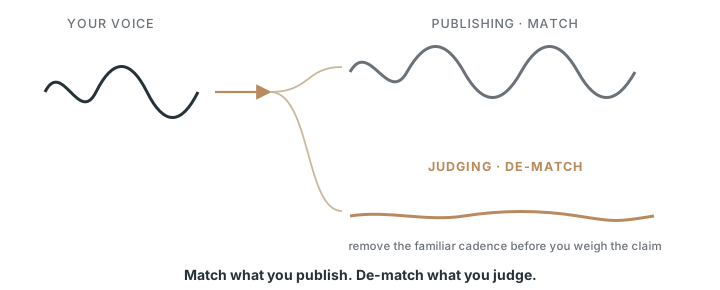
- Publishing → match. Prose you’ll ship should sound like you. Voice-match, a keep-list (the lines you mark to preserve), the works.
- Judging → de-match. A review, a critique, a “here’s what’s wrong with this” — ask for it plain, terse, even adversarial: “critique this as a hostile stranger — no hedging, and don’t use my phrasing.” Strip the shared cadence so nothing rides in on familiarity.
- Or mark the seam. If you can’t change the register, make it label its own confidence — checked vs inferred vs guessed — so fluent sentences can’t all read at the same weight. That’s Confidently Wrong’s move, applied to voice.
The thread tying all of it together is the one this whole site keeps landing on: the judgment stays yours, so protect the conditions under which you judge. A voice you trust is a fine thing to publish in and a dangerous thing to be graded by.
How sure I am: Medium on the mechanism, lower on the size of the effect for AI specifically. The underlying biases — fluency raising judged truth, mere exposure raising preference, automation complacency raising deference — are well-established in humans generally. That voice-matched AI output triggers them is a reasoned extension, not something I’ve measured: I’m confident of the direction, not the magnitude. The lived part is real but indirect — the How sure I am convention on this site is a countermeasure I built against fluent-output over-trust before I could have named the bias. The clean test I haven’t run: give myself the same critique in my own voice and in a cold register, and count which one I scrutinise harder. That would turn this from argued to shown.
Sources
- Daniel Kahneman, Thinking, Fast and Slow (2011) — cognitive ease; familiarity is not easily distinguished from truth.
- Reber & Schwarz, “Effects of Perceptual Fluency on Judgments of Truth,” Consciousness and Cognition 8(3), 338–342 (1999), and the broader processing-fluency literature — ease of processing raises judged truth.
- Zajonc, “Attitudinal Effects of Mere Exposure,” Journal of Personality and Social Psychology 9(2, Pt. 2), 1–27 (1968) — the mere-exposure effect; familiarity raises preference.
- Parasuraman & Riley, “Humans and Automation: Use, Misuse, Disuse, Abuse,” Human Factors 39(2), 230–253 (1997) — over-reliance (“misuse”) on automated systems generally; the fluency-specific link is my own extension, not their finding.
- This site’s own How sure I am convention, and my sessions — the lived countermeasure. Working artifacts, genericised.
Related: Confidently Wrong (the sibling — confidence isn’t trust; here, familiarity isn’t trust), The Agent Reaches for the Nearest Metaphor (the voice-mirroring that carries your words into its prose is the mechanism that makes the output feel like yours), Give Away the Writing (voice-match doing its right job — prose headed out the door).