
Where the Reps Come From
updated
“For the things we have to learn before we can do them, we learn by doing them.” — Aristotle
BLUF: Bottom line up front
- The reading series is a retention frame. Those posts on keeping the reading — anchored by Give Away the Writing, Keep the Reading — say keep the reading, guard the residue, hold the skill a year out. They speak to people who already trained the old way — write the first draft, hit the wall, read their own broken code — and tell them how not to lose the eye. This post is about the cohort they never address: the engineer who arrives after AI already writes the first draft.
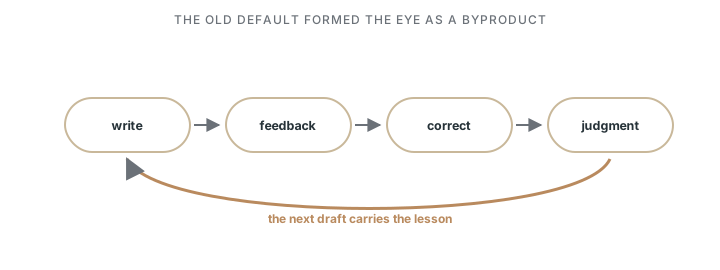
- Judgment used to form as a byproduct of the job. Writing code you didn’t yet understand, owning the bug you wrote — that was the bottom rung, and it built the eye whether or not you meant it to. AI removes exactly that rung.
- So for this cohort, judgment has to be built deliberately or it may not form at all. The default path that built it for free — as a byproduct of writing the first draft — is gone. This isn’t atrophy — atrophy is losing something you had; this is the harder case of never having acquired it.
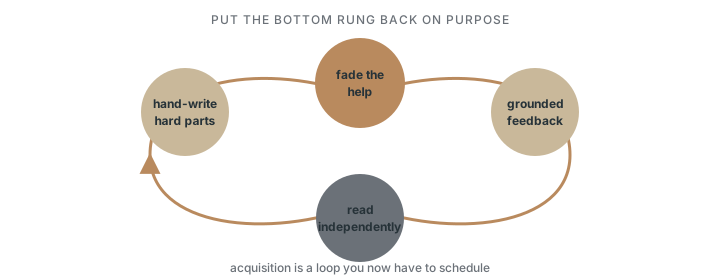
- The mechanisms already exist; they were written as maintenance. Write the hard parts by hand, fade the help and practise protected, run the reps with feedback. For the trained eye those are optional upkeep. For the cold-start engineer they’re the deliberate substitute for a default that no longer runs on its own.
- The productivity numbers assume the reading still happens. They price the machine and take the competent reader as given. The job produced that reader for free, and that subsidy is ending.
The numbers assume a reader
You’ve seen the pitch. The sober version is Anthropic’s own estimate — Claude, reading a hundred thousand real conversations, estimated that AI cut task time by around 80% (a model’s estimate across all kinds of work, not an observed measurement and not specific to software; Anthropic itself notes it may overstate the gains). The loud version is the viral “an AI engineering team replaced a whole department” claim — the kind that trends without a citable result behind it. Take the sober number and leave the loud one where you found it.
Even the sober number routes through one quiet assumption: someone at the end of the loop can tell whether the output is right. Give Away the Writing named that seat — the reading, the one act in the loop that owns intent. The numbers price the machine and take the reader as given (my reading of the gap, not a claim the report makes). Fine, today: the reader learned to read the old way. The question the numbers never ask is who’s sitting in that seat in ten years, if the job has stopped producing anyone who can.
The series was written for people who already trained
Say the thing the reading series doesn’t. It is a retention story from front to back. The Productivity Mirage’s gate — do I want to still be able to do this without the tool a year from now? — presupposes you can already do the thing. Thinking at the Speed of Code is about a reflex you built and want to keep sharp: “the difference is the reps,” reps you already ran. Give Away the Writing tells you to hand-write the hard parts “while the instinct is forming” — forming, on the old default, where writing the first draft is still your job.
All three address someone who has the eye or is in the middle of getting one the ordinary way. None of them address the person who shows up when writing the first draft is no longer part of the work. Tell that person to “keep the reading” and there’s nothing yet to keep.
The rung AI saws off first
A designer on my team started opening PRs. Real front-end work — the kind of UI they’d normally spec and hand to an engineer, now produced with an AI and shipped as code. The changes worked. They looked right. And my reviews filled up with things the diff gave them no way to see: a create call that didn’t wait for the thing it was creating, so the record could be read before it existed; a component whose “controlled” mode hinged on one prop being passed, with nothing in the types to enforce it, so it could silently never close; a store named after a screen it had nothing to do with — I could tell it was AI-generated, they couldn’t. Working UI on top; underneath it, engineering they had no reps to catch. They could produce the code. They couldn’t read it.
The designer is just the early, visible version. Before AI they’d never have shipped that PR at all — the tool is what put unreadable code under a name with no reps behind it. The same gap is now opening one level up, for the engineer who starts out when the first draft is already the AI’s.
Here’s what that person is missing, and it was never motivation. The eye never got taught on purpose. It fell out of the job. You wrote something that didn’t fit and the codebase told you. You shipped a bug and then owned it at 2am. Nobody scheduled those reps — they were the byproduct of being the one who wrote the first draft. The judgment formed on the side, whether or not you were trying to build it.
That byproduct is, my bet, exactly what the tool removes, because the first draft is what it’s best at. The senior kept the judgment because they built it before the tool arrived. The cohort behind them is being handed the top of the ladder with the bottom rung gone — asked to review what they were never made to write.
This is not the “juniors will atrophy under AI” alarm, which is everywhere and mostly right and not the point. Atrophy is decay of a skill you once had; the cold-start problem sits upstream of that. The default path that used to build the skill for free has been automated, and nothing has stepped in to replace it as the default. Other paths still build judgment — debugging the code the tool generated, code review, mentorship, ops — but none of them runs automatically the way writing the first draft did. The skill now has to be gone after on purpose, or it may not arrive.
You can’t skip straight to reading
The tempting reply: fine, they’ll learn to read instead of write. But Thinking at the Speed of Code already showed why that doesn’t come free: the fast read is trained pattern-recognition, and it needs the two conditions that piece lays out — valid cues and practice with feedback. The consequence here is direct — read without ever having built, and there’s no model for a wrong shape to snag on. And won’t reviewing the AI’s output build the reps back? Only if you can already read it. Review compounds a skill you have; it can’t bootstrap one you don’t — the designer reviewed their own PR and shipped the bug anyway. Feedback only teaches once you can tell whether the feedback is right.
Give Away the Writing compressed it to a line: write to build the judgment, read to keep it. This cohort is being asked to keep what it never built. The reading is the durable skill now. You reach it by running the reps, not by skipping past them.
Manufacture it, or don’t have it
So the reps have to be put back on purpose. I won’t re-derive the mechanisms; they’re already written down, and this post’s only job is to point them at a reader the originals didn’t have in mind.
- Hand-write the hard parts — Give Away the Writing. For the trained eye that’s a few passages a week. For this cohort it’s the parts they’d otherwise build no judgment on at all.
- Fade the help, keep a protected practice — The Productivity Mirage’s protected-practice loop and its residue test. Run the same machinery; you’re just not testing whether the skill survived, you’re building it the first time.
- Run the reps against feedback — Speed of Code, the loop closed: a test goes red, a bug surfaces, a reviewer confirms the catch.
The gate inverts. The mirage’s retention gate asks do I want to still be able to do this in a year? — a question you can only ask about a skill you already have. The acquisition gate asks a harder one: can I do this at all yet, is it a thing I need to be able to do, and — since the default won’t build it for me — how do I run the reps by hand? Same machinery, opposite starting point. Retention protects a callus. Acquisition has to raise one, deliberately, on a job that no longer raises it for you.
And it’s already visible in the trade press. InfoWorld’s “Seven sins of the modern software developer” catalogues the pattern — foundational theory handed to the tool, documentation gone unread, debugging skipped — as a list of vices; underneath, it’s the byproduct-formation loop being skipped in real time, unnoticed because the output still ships. A separate InfoWorld piece names the consequence outright: teams may end up without the skills to validate and debug AI-written code, because the skill formation was inhibited by using AI in the first place.
The bill nobody’s funding
Back to the numbers. The gains are real — take Anthropic’s own sober estimate as the anchor, not the loud version. But a gain that routes through a competent reader is borrowing against a stock of competent readers the industry never had to fund. The job minted them as a side effect. Now the side effect is the first thing automated.
Read the productivity number and staff accordingly, and you’re spending down a reserve the default job no longer refills. The bill doesn’t come due this quarter. It comes due the year the last engineer who learned to read the old way retires, and the seat that owns intent has nobody in it who ever built the eye. Manufacture the reps, or accept that they may not show up on their own — the byproduct that used to supply them is the thing the tool replaced.
How sure I am: Low-to-medium, and split. The retention side I’ve lived — I built the eye by writing and now read far more than I write, which is the sibling posts’ territory. The acquisition claim is reasoned, not lived: I didn’t learn under a tool that writes the first draft, so I’m arguing from the mechanism, not from having come up that way. Formation-under-AI is unmeasured; the “byproduct removed, so manufacture or absence” claim and the inverted gate are a wager, flagged as one. If it holds, it holds because the reps have always had to come from somewhere — not because anyone has run the experiment.
Sources
- Give Away the Writing, Keep the Reading — formation home: “write to build the judgment; read to keep it.” This post extends that beat to the cohort with no default writing phase.
- Thinking at the Speed of Code — reps home: the fast read is trained pattern-recognition, “the difference is the reps,” and Kahneman & Klein’s two conditions (valid cues + feedback).
- The Productivity Mirage — the retention gate and the protected-practice / residue-test loop this post borrows and inverts from retention to acquisition.
- “Seven sins of the modern software developer,” InfoWorld — the craft-erosion pattern in the trade press (theory handed to the tool, docs unread, debugging skipped). Paraphrased, not quoted verbatim.
- “AI use may speed code generation, but developers’ skills suffer,” InfoWorld — names the consequence outright: teams may lack the skills to validate and debug AI-written code because skill formation was inhibited by using AI in the first place. The thesis, in trade-press words.
- Anthropic, “Estimating AI productivity gains” (anthropic.com/research/estimating-productivity-gains) — across ~100k real conversations, Claude estimates AI cuts task-completion time by ~80%; the sober anchor. Anthropic itself notes the estimate may overstate gains.
- The “an AI engineering team replaced a department” genre — used as an over-claim foil, not as evidence, and deliberately uncited: it trends as viral posts, not citable results. The specific dollar figures that circulate don’t trace to a rigorous source, so the post cites none.
Related: Give Away the Writing, Keep the Reading; Thinking at the Speed of Code; The Productivity Mirage.